© www.regionleipzig.de, Tourismusverband Leipzig Region
Außenansicht des Doms St. Marien in Wurzen, großes historisches Kirchengebäude mit Turm und sichtbarer Fassade.
www.pkfotografie.com, Philipp Kirschner | CC-BY

Martin Luther, the reformer of the 16th century, profoundly changed church and society with his ideas. Yet he never worked alone: companions such as Philipp Melanchthon, Katharina von Bora or the reformist scholars of his time supported him in teaching, publishing and organisational work. Together, they advocated for the spread of the Bible in the German language, for education and for the freedom of faith. They helped ensure that Luther’s teachings could have an impact not only in Wittenberg, but throughout Saxony and beyond.

Along the Luther Trail in Saxony, you can trace the footsteps of these important figures – whether in historic towns, churches, monasteries or places where they preached, reformed or advanced social projects together with Luther.

www.pkfotografie.com, Philipp Kirschner | CC-BY

Martin Luther

  • Lifetime: November 10, 1483 – February 18, 1546

  • Age: 62 years

  • Calling & work: German theologian and initiator of the Reformation

  • Beginning of the Reformation: On October 31, 1517, Luther published his 95 Theses against the sale of indulgences

Martin Luther

Porträt von Martin Luther, Reformator und zentrale Figur der Reformation, in historischer Darstellung.
gemeinfrei  | CC0

Martin Luther, a German theologian, monk, and professor, is considered a central founder of the Reformation. With his criticism of the abuses within the Catholic Church, especially the sale of indulgences, he set impulses for a renewal of faith. These would have an impact far beyond Wittenberg and ultimately led to the division of the Catholic and Protestant churches.

His life was shaped by significant events that profoundly changed the church, society, and education. From his birth and the key stages of his work to his death, the most important milestones of his life can be traced. Exploring his legacy today offers fascinating insights into the Reformation era and shows how individual people can influence history in the long term.

Martin Luther’s biography

11/10/1483 Birth of Martin Luther in Eisleben
1501 Start of his studies in Erfurt
1505 Master’s degree
1505 Entry into the Augustinian Hermit Monastery in Erfurt
1507 Ordination as priest
1507 Beginning of theological studies in Erfurt
1508 Transfer to the University of Wittenberg, beginning his teaching activities in Wittenberg
1510 Journey to Rome
1512 Doctorate in Theology
10/31/1517 Publication of the 95 Theses
1519 Debate with Johannes Eck at the Pleißenburg in Leipzig
1521 Diet of Worms; defense of the 95 Theses before the emperor and the prince-electors at the Diet of Worms; imperial ban imposed on Luther
1521 - 1522 Luther is hidden on Wartburg Castle as "Junker Jörg"; translation of the New Testament into German
1525 Marriage to Katharina von Bora / Outbreak of the Peasants’ War
1530 Confessional Diet in Augsburg; Luther accompanies the Diet from Coburg Fortress; Luther and Melanchthon write the Augsburg Confession, considered the first confessional document of the Lutheran imperial estates
1534 First complete edition of the German "Luther Bible"
02/18/1546 Death of Martin Luther in Eisleben
www.pkfotografie.com, Philipp Kirschner | CC-BY

Group trip to Grimma and Torgau

"In the Footsteps of the Reformation"

www.pkfotografie.com, Philipp Kirschner | CC-BY

Luther’s companions

Lutherdenkmal vor der St. Nicolaikirche in Döbeln, Darstellung von Martin Luther auf dem Kirchenvorplatz.
© Elias Rost

The Reformation would not have been possible without the companions at Luther's side. Key figures who worked closely with him, such as Philipp Melanchthon and Katharina von Bora, supported him in teaching, publishing, and organization and helped ensure that his ideas could take effect in Saxony and beyond. They contributed to laying the foundations of a new world of faith and significantly shaped the Reformation through education, diplomacy, and personal closeness. 

The following portraits present the most important personalities at Luther's side and show how collaboration, trust, and shared visions influenced the course of history.

Notable figures

Porträt von Katharina von Bora, Ehefrau Martin Luthers, in historischer Darstellung.
gemeinfrei | CC0

Katharina von Bora (1499–1552)

Katharina von Bora was a central figure of the Reformation period and closely connected with Luther. Originally a nun in the Saxon Cistercian convent in Nimbschen, she fled to Wittenberg in 1523 together with other nuns, inspired by Luther's writings.

There, she first lived and worked in the home of the painter Lucas Cranach. In 1525, she married Martin Luther, with whom she had six children. Her influence was not limited to household and family; she also supported her husband in theological matters and offered him insightful advice.

After Luther’s death, she left Wittenberg in 1552 and died shortly afterward in an accident in Torgau. Her tombstone can still be seen today in the Marienkirche in Torgau.


Tour: Katharina von Bora
Porträt von Philipp Melanchthon, Theologe und Weggefährte Martin Luthers, in historischer Darstellung.
gemeinfrei | CC0

Philipp Melanchthon (1497–1560)

Philipp Melanchthon was one of Martin Luther’s closest companions and played a key role in shaping the Reformation as a scholar, humanist, and theologian. As a professor at the University of Wittenberg, he advocated for a comprehensive reform of education and laid the foundation for a new education system shaped by humanist ideas through the expansion of schools and universities.

With writings such as the *Confessio Augustana*, he formulated the central principles of the young Protestant Church. He is also said to have encouraged Luther to translate the Bible into German that ordinary people could understand.

When Luther was no longer able to move freely due to the 1521 Church ban, Melanchthon increasingly took on the role of spokesperson for the Reformation—and remained so even after Luther’s death. His deep bond with Luther is reflected in his well‑known statement: “I would rather die than be separated from this man.”


Learn more
Porträt von Lucas Cranach dem Älteren, Maler und Weggefährte Martin Luthers, in historischer Darstellung.
gemeinfrei  | CC0

Lucas Cranach (1472-1553)

Lucas Cranach the Elder was one of the most important artists of the Reformation period and a close friend of Martin Luther. As court painter to the Saxon electors in Wittenberg, he not only created impressive portraits of Luther and other reformers, but also played a key role in spreading Reformation ideas through his art.

His workshop produced leaflets, book illustrations and altarpieces that visually conveyed the new religious ideas. Cranach mastered the art of translating theology into images — striking, accessible and full of symbolism. In this way, he became one of the most important ambassadors of the Reformation and shaped its appearance to this day.


Learn more
Porträt von Elisabeth von Rochlitz, historische Darstellung der Persönlichkeit.
gemeinfrei  | CC0

Elisabeth of Rochlitz (1502–1557)

Elisabeth of Rochlitz was one of the most remarkable women of the Reformation period. As Landgravine of Hesse and Duchess of Saxony, she held an important political and religious position. Contrary to the expectations placed on noblewomen at the time, she actively supported the spread of Reformation ideas and supported both Martin Luther and other reformers.

Under her influence, Rochlitz Castle became a centre of intellectual and religious development. She enabled Reformation sermons, promoted the establishment of Protestant congregations, and played a decisive role in helping the Reformation take root in central Saxony. Elisabeth of Rochlitz was regarded as an educated and dedicated princess whose initiatives left a cultural and religious legacy.


Guided tour of Rochlitz Castle
Porträt von Georg Spalatin, Berater und Wegbegleiter Martin Luthers, in historischer Darstellung.
gemeinfrei  | CC0

Georg Spalatin (1484–1545)

Georg Spalatin was one of Luther’s closest confidants. As court chaplain and secretary to Elector Frederick the Wise, he acted as a liaison between Luther and the Saxon court and played a key role in ensuring that Luther’s writings and ideas gained political support.

As a skilled diplomat, he negotiated both Luther’s appearance before the Emperor in Worms and his refuge at Wartburg Castle after the imperial ban was imposed. Spalatin was not only a diplomat, but also a scholar, translator, and chronicler of his time. Through his close friendship with Luther and his work as an advisor, he became a key figure in the Reformation movement. After the death of Frederick the Wise, he distinguished himself as an important historian of the new Protestant church.


Learn more
Porträt von Friedrich dem Weisen, wichtiger Förderer und Wegbegleiter Martin Luthers.
gemeinfrei  | CC0

Frederick the Wise (1463–1525)

Frederick the Wise, Elector of Saxony, played a decisive role during the Reformation. In 1502, he founded the University of Wittenberg, where Luther and Melanchthon would later study and teach. As a supporter of education, art, and science, he enabled Martin Luther to develop and spread his theological ideas freely. Although Frederick himself was not a follower of Luther’s theology, he was considered his patron and protector.

He became famous mainly for his decision to protect Luther after the Diet of Worms in 1521 and to have him taken to Wartburg Castle. There, Luther translated the Bible into German — a work of great significance for the Church and society. Frederick combined political skill with a strong sense of justice and freedom of belief and contributed significantly to allowing the Reformation to take root in Saxony.

Despite his support for the reform movement, he did not profess the Protestant faith until his deathbed. For diplomatic reasons, he had never met Luther personally.


Learn more
Porträt von Martin Bucer, Reformator und Zeitgenosse Martin Luthers, in historischer Darstellung.
gemeinfrei  | CC0

Martin Bucer (1491–1551)

Bucer was one of the most influential reformers of the 16th century and helped shape the spread of the Reformation far beyond Strasbourg. As a theologian, he worked to implement Reformation ideas within the church and society. Community, education, and well‑structured parish work were especially important to him.

Bucer was regarded as a skilled mediator between different Reformation movements and played a key role in unifying and stabilizing the young Protestant movement.

In close exchange with Martin Luther and other reformers, he promoted the spread of the Reformation beyond Germany to Switzerland and France. His work had a lasting impact on Protestant church order and left a permanent legacy in the history of Protestantism.


Learn more
Porträt von Johannes Bugenhagen, Theologe und Weggefährte Martin Luthers, in historischer Darstellung.
gemeinfrei  | CC0

Johannes Bugenhasen (1485–1558)

Johannes Bugenhagen was one of the most important reformers in northern Germany and a close ally of Martin Luther. As a theologian and pastor, he played a key role in putting the ideas of the Reformation into practical action in congregations and cities. He developed church ordinances for numerous northern German cities, helped translate the Bible into German, and was directly involved in shaping the new religious order. Later, he crowned Christian III of Norway and Denmark as the first Protestant king, thus helping to spread the Reformation beyond the borders of Saxony.

Learn more
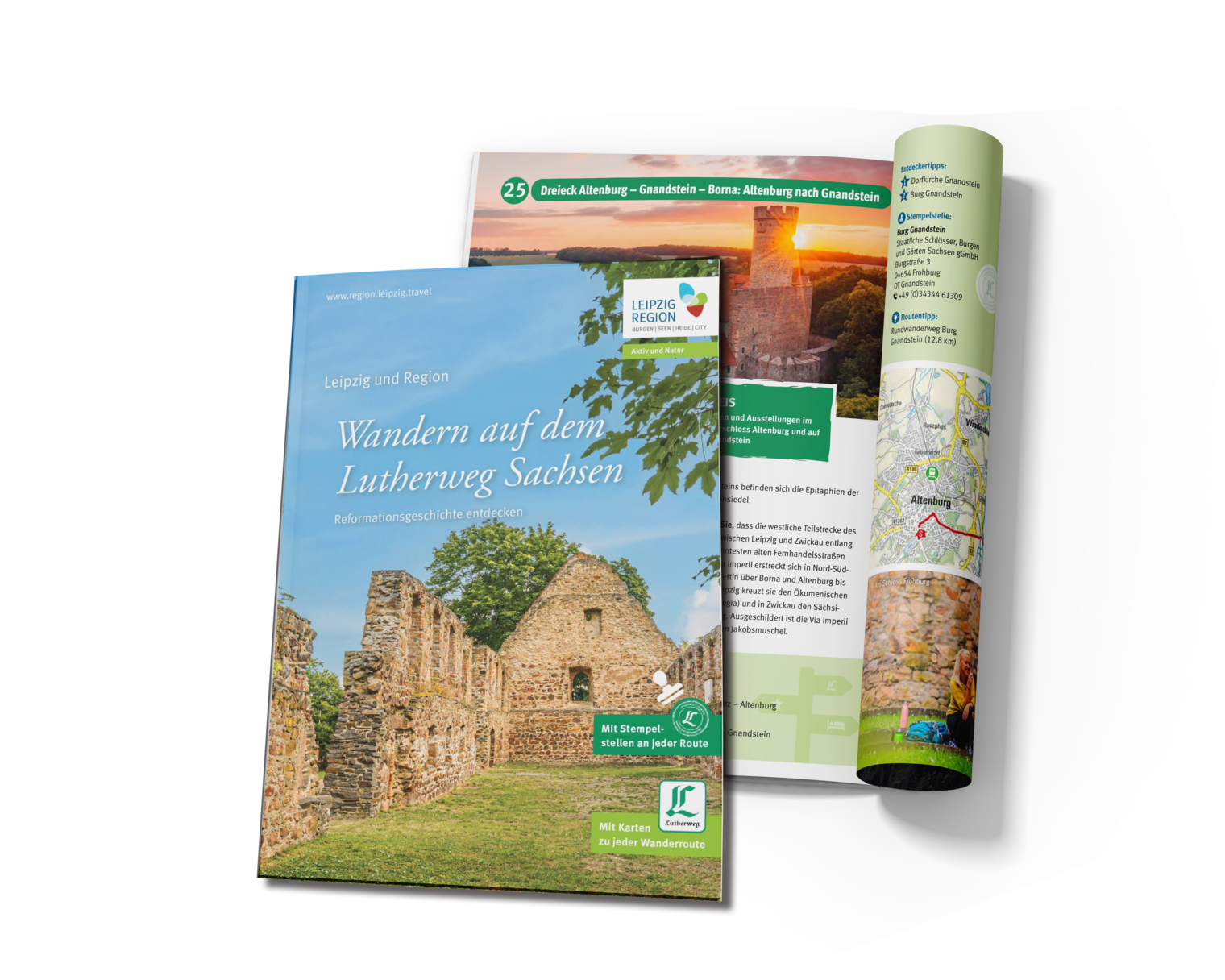
DAs Bild zeigt das Cover der Lutherweg-Broschüre
© www.leipzig.travel, Leipzig Tourismus und Marketing GmbH

Luther Trail in Saxony 

Discover Reformation history

Along 31 stations, the Luther Trail in Saxony leads as a spiritual circular hiking trail through significant places where Martin Luther and his companions lived and worked in Saxony.

Faith is the beginning of all good works.
Martin Luther

FAQs