Wermsdorf


The municipal area is located in the south-western part of the district of North Saxony. Including its districts of Calbitz, Collm, Gröppendorf, Lampersdorf, Liptitz, Luppa, Mahlis, Malkwitz, Wadewitz and Wiederoda, the municipality covers an area of 105 km². A large part of this is made up of forest and water areas.
A variety of archaeological finds prove this: Wermsdorf and its surroundings were already a settlement area for people from the Stone, Bronze and Iron Ages. The cultural landscape museum at the church pond in the western Wermsdorf forest invites visitors on a 3200-year journey back in time with its sophisticated display boards. The excavations that take place every summer gradually reveal the history of the settlement area.
The backdrop of the two Wermsdorf castles is particularly impressive. The Old Hunting Lodge was built between 1607 and 1610 by Christian II and rebuilt and extended by Elector Johann Georg I in the German Renaissance style between 1617 and 1626. The master builder Simon Hoffmann created a three-winged complex with an octagonal stair tower and ornate sandstone work. Today, the Old Hunting Lodge houses the municipal administration, tourist information and a cultural center. The renovation of the west wing of the Old Hunting Lodge was completed in 2023. Coworking spaces, club rooms and a studio were created in this building. The former stables are captivating with their charm and are popular with artists as an exhibition space.
The royal and electoral palace complex of Hubertusburg was built between 1721 and 1724 on the orders of Augustus the Strong. Master builders such as Ch. Naumann, J. Ch. Knöffel and J. H. Schwartze gave the complex its shape. As a masterpiece of Dresden Baroque, it is one of the largest hunting lodges in Europe and was once the largest country palace in Saxony. Moreover, it was not just a castle - it was a Saxon residential palace. Hubertusburg's "heyday" came to an abrupt end during the Seven Years' War. In 1761, it was completely plundered by Prussian troops. Only the Catholic chapel remained intact. The "Peace of Hubertusburg", which ended the war in 1763, made the castle part of European history. Today, the Catholic chapel, which was completely restored in 2007, the royal box, the restored oval hall (only open to visitors on guided tours via the tourist information office) and a display board tour set up in 2011 impressively tell the story of the former residential palace.
Wermsdorf is not only worth a visit because of its castles. It is the forest surrounding the town that creates the necessary atmosphere for rest and relaxation. The extensive woodlands cover more than half of the municipal area. The Wermsdorf forest is ideal for hiking, cycling and horse riding. Augustus the Strong had the forest set up for par force hunting by his governor. We have this to thank for the extraordinary network of paths in Wermsdorf Forest. The layout of the paths, which has been preserved to this day, is the basis for a well-signposted network of hiking trails with plenty of seating areas and rest stops.
For the purpose of fish farming, 26 artificial ponds were created around the village. Around 500 years ago, dams were built in the lowlands of streams, in front of which the water was dammed up. Together with the Wermsdorf forest, the numerous ponds promise pure nature.
The most famous lake in Wermsdorf, Horstsee, is the site of Germany's largest inland fishing festival, the Horstseeabfischen, which takes place every year on the second weekend in October and features the reigning fish queen and Augustus the Strong. The festival attracts tens of thousands of visitors from near and far. Visitors can marvel at the traditional fish procession, enjoy the aroma of freshly smoked fish, take home freshly caught fish or simply try everything on the spot. In addition, around 100 traders, showmen with small and large rides and a large marquee with a colorful program for everyone ensure a great atmosphere.
Unique traditional festivals have developed throughout the municipality. The New Year's swimming in the Luppa natural pool, the Castle Night in Wermsdorf, the marriage market in Collm, the park festival in Calbitz and many more take place every year. A special highlight in the municipality's calendar of events is the traditional drag hunt, which takes place every two years in September. Not only horse and dog lovers get their money's worth at this event, which is held in the spirit of Augustus the Strong. Over obstacles on horseback, past them in a wagon, always following the pack of dogs, with a hearty break from the hunt and a hallelujah in the Hubertusburg courtyard, active participants and onlookers experience an unforgettable day.
In the pre-Christmas period, visitors can look forward to an extraordinary spectacle all about the goose and everything else that makes Christmas perfect, right on the Eskildsen goose farm. On over 1,000 m² you will find both live and slaughtered geese, goose delicacies of all kinds, fresh carp and fish specialties, bread, herbs, juice and mulled wine, game specialties, arts and crafts, Christmas decorations and Christmas trees in a cosy atmosphere. Above all, you will find the products of regional suppliers at Gänsemarkt Eskildsen. There is also plenty to eat and drink and you can enjoy a good roast goose on site.
Another popular excursion destination is the Collm, probably the oldest mountain in Saxony, with its Albert Tower (observation tower). With its height of 312 m, the Collm is the most striking elevation in the North Saxon lowlands. In 1865, the Collm was an important station of the Central European degree measurement; a column-shaped granite pillar on the south side of the tower commemorates this event. From the local Albert Tower, you can enjoy a far-reaching panoramic view of the region and the Wermsdorf Forest. Idyllically situated at the foot of the mountain, you will find the Collm district. Saxony's oldest lime tree stands in the cemetery in the center of the village. It is a proud 18 meters high, has a trunk circumference of 11 meters and is over 1,000 years old. Law was dispensed under this lime tree in the Middle Ages and Martin Luther is said to have rested here.
The Luppa natural pool is an oasis for swimmers, surfers and anglers. In addition to the clear water, those seeking relaxation will also find opportunities for treading water and boating. Also worth seeing is the windmill in Luppa, which is lovingly maintained and looked after by the local heritage association.
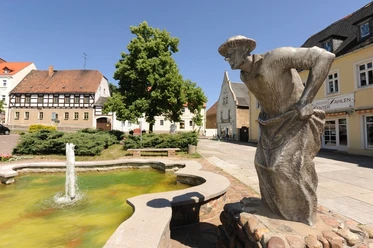
In the district of Kötitz, the local heritage association has created the "Kötitz Sculpture Park" in collaboration with many helpers and artists from the Prösitz artists' estate. In addition to two ponds and a very old tree population, there are also several modern brick sculptures in the elongated park.
The inns and restaurants in the municipality of Wermsdorf make a decisive contribution to physical well-being with their culinary delights, especially regional fish, goose and game specialties, and an innovative ambience. Hard-working and hospitable locals are proud of what they have created. They look forward to welcoming all guests, whether they are staying in a hotel or guesthouse or visiting Wermsdorf as a day tourist.
For further information or individual offers, the Wermsdorf tourist information office is at your disposal and can arrange guided tours, accommodation and event tickets. Take a look at the town and its sights before your visit with the digital tour.

Good to know
Directions & Parking facilities
- Anreise
By car: Via A14: Take exit 32 Mutzschen. Follow the S38 to Wermsdorf. Via B6: In Luppa turn off in the direction of Wermsdorf onto S24.
Öffentliche Verkehrsmittel
Take the RE50 to Dahlen station. In Dahlen change to bus route 816 (Mügeln via Wermsdorf) to Wermsdorf Hirschplatz. Author
Kathleen Schramm
Organization
LEIPZIG REGION
License (master data)
Kathleen Schramm