The character of the idyllic heathland is determined by flat and hilly coniferous and mixed forests, which are charmingly interrupted by small stream valleys with meadows and ponds. Rare plants and animals are at home here and over 100 bird species nest in the heathland, where the well-known zoologist Dr. Alfred Brehm enjoyed observing animals.
The Dahlen Heath has a very well signposted network of hiking, cycling and riding trails and also invites you to swim, feast and enjoy. If you take the time, you can go on beautiful hikes. Worthwhile excursions include Brehms Ruhe, Tabakskiefer, Jägereiche, Dahlequelle, Sieben-Quellen-Tal with its H-beech, Nixentümpel or the Toten Magd. Fixed huts invite you to take a break and offer shelter in wind and weather.
The heath town of Dahlen is located in the middle of the major cities of Leipzig, Dresden and Chemnitz, in the heart of Saxony. Mentioned in documents as early as 1188 and granted a town charter in 1228, Dahlen has experienced severe setbacks such as wars, town fires, plague and famine in the course of its development. Due to its favorable location on two trade routes, it was always able to recover economically.
Dahlen has always had the typical character of a small country town thanks to its extensive agriculture and forestry. Today, people live in the heath town with its districts: Schmannewitz, Ochsensaal, Börln, Bortewitz, Großböhla, Kleinböhla, Neuböhla and the Schwarzer Kater, have a population of around 4600.
The market square with the town hall, built in its present form in 1888, and the adjoining town houses give the town center a harmonious appearance. According to legend, Dahlen is also known as the "Sackhupper town" - hence the Sackhupper on the Dahlen market square.
Nearby is the local history museum with its still-functioning music machines and a small collection of weapons.
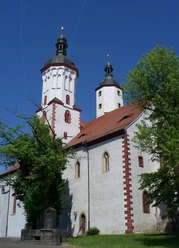
Not to be overlooked is the town church "Unser Lieben Frauen", which can look back on over 500 years of history. Particularly worth seeing is the Annen altar and the mural on the south side of the high choir, which depicts St. Christopher with the Christ Child.
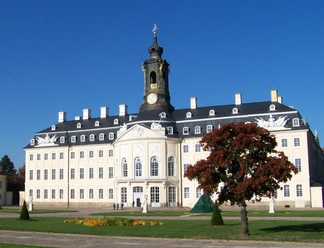
The castle and the castle park with the oldest tulip tree in Saxony characterize today's image of the heath town of Dahlen.
Bortewitz is a small village on the edge of the Dahlen Heath between Börln and Schmannewitz. A special feature of this small village is the clock tower. As Bortewitz did not and still does not have a church, a Leipzig fur trader and hunting tenant donated money to build such a tower. So at least you could read the time from afar. Today, the local fire department uses the clock tower.
Ox hall
Ochsensaal, a village surrounded by forest ponds and woods, is an ideal starting point for hikes in the area around the Schildberg or to the Sieben-Quellental. Ochsensaal has a long tradition as a vacation resort. The village church probably dates back to the 12th century. The largest burial mound from the Late Bronze Age on the Dahlen Heath is located in the Heinitz forest area on the A-road. Southwest of Ochsensaal is the largest pond in the Dahlen Heath, the Dammühlenteich, which covers 13 hectares. There is an inn with a guesthouse and a campsite here.
About one kilometer south of the village is the Markusteich pond with adjoining moorland meadow, as well as the Nixentümpel pond nearby.
Börln
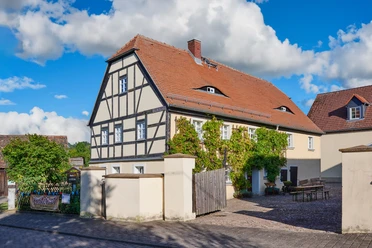
The townscape is characterized by a large number of three-sided farmsteads - the first traces can be traced back to the Bronze Age, as impressively demonstrated by the surface graves south of the village.
Börlner Schloss, which is now privately owned, was built in the late Baroque period on the remains of a moated castle. A moat still partially exists around the castle. Today, concerts, art exhibitions and cultural events are held in and around the castle.
Großböhla, Kleinböhla & Neuböhla
The three districts have been part of the heath town of Dahlen since 1994. Kleinböhla with its "Tellerhölzchen" island is the starting point of the Böhla villages. The "Tellerhölzchen", a small natural and historical monument, is an early medieval moated castle, also known as Turmhügelberg. Its main features have been preserved to this day. Neuböhla was created between 1947 and 1950 in the course of the land reform of 1945. In the 15th century, a knight's seat with a manor developed in Großböhla. The most beautiful and best-preserved building is the castle in Großböhla. We owe the "face" of the castle to the noble von Bültzingslöwen family, who lived in Großböhla from 1921 to 1945. Today, children's laughter can be heard from the castle. The former castle park - now the Böhla public park - is particularly charming. With its many ponds, winding paths and interesting flora and fauna, it offers relaxation and enjoyment.
Schmannewitz
The state-approved resort of Schmannewitz is probably the best-known vacation resort in the Dahlen Heath in over 100 years of history. The famous zoologist and world traveler Alfred Brehm also stayed as a guest in the Dahlen Heath - on the 50th anniversary of his death in 1934, the memorial stone "Brehm's Rest" was erected in his honour in the forest north of Schmannewitz.
There is a wide range of accommodation and leisure facilities. In 1996, two rehabilitation clinics were opened in Schmannewitz: the Christiaan Barnard Clinic, a specialist clinic for cardiology, oncology and psychosomatics, and the Dahlener Heide Rehabilitation Clinic, a specialist clinic for orthopaedics and psychosomatics. The Schmannewitzer Rüstzeitheim is an attractive address for families with children, singles and senior citizens.
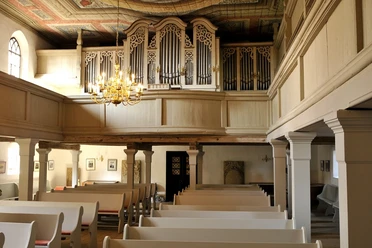
Schmannewitz has a cultural and historical attraction with its baroque village church. The plans for the church, built in 1732, were drawn up by the famous George Bähr. Also worth a visit are the "Rural Museum", a renovated trestle windmill, the fire department history exhibition, the animal enclosure and the forest pool with its giant slide.

Directions & Parking facilities
- Anreise
By car: Follow the A14 to S38 in Grimma, take exit 32-Mutzschen on the A14. Follow S38, Grimmaer Str., Dahlener Str., S24, Wermsdorfer Str. and S24 to Dr.-Alfred-Brehm-Straße in Dahlen.
Öffentliche Verkehrsmittel
From Leipzig main station take the RE50 to Dahlen, from Oschatz take bus 781 to Schmannewitz, Torgauer Straße. Author
Kathleen Schramm
Organization
LEIPZIG REGION
License (master data)
Kathleen Schramm